Welcome to Teaching Students with Visual Impairments
|
Block PlayBy: Carmen Willings
teachingvisuallyimpaired.com Block play is a station that is typically found in classrooms for younger students. It lends itself to so many skills including imagination & creativity, math concepts and even language can be incorporated. Of course when the building is done, it also can be a great place to practice cleaning up! Block play is an area that naturally incorporates math skills. It can provide opportunities for learning classification; shape, size and color identification; and counting and matching skills. Students count, measure, balance, plan, problem solve, and develop language. It incorporates scientific concepts of balance, space, and gravity. It also can facilitate cooperation development in social relationships. Begin with the basic blocks in the black area and then enhance with theme specific materials.
Common materials in the block area include dollhouses, miniature furniture, toy people, cars and trucks, animals, unit blocks, large wooden blocks, plastic blocks, cardboard blocks (fill to create different weights), bristle blocks, Duplos, Lego's, animals, and road signs. In selecting toys, choose ones with a variety of textures, weights, and sizes.
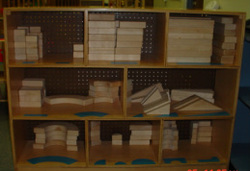
Incorporate concepts into the Blocks Station by: discussing likes and differences of blocks and building materials; size (big/little and small/medium/large) and quantity differences of blocks, cars, etc.; sound differences of train and car race sets or blocks crashing down; and shapes of blocks and building toys. Encourage students with low vision to use their magnifiers to study directions for LEGO assembly, study maps, and study blueprints. Also encourage students with low vision to use their vision during blocks to watch the movement of friction cars or small windup toys.
Provide block outlines (high contrast and raised line for tactual learners) to assist students in putting blocks away. Attach object and print/braille word to the top or front of containers for students who are at a pre-symbolic level. For students that can understand symbols and will be a future print reader, use picture and word symbols to label containers. The block area should be protected on at least two sides, ideally three, to minimize structures getting mistakenly knocked over. This will also help contain the creative area! It is best to have plenty of floor space and low pile carpet that will keep buildings from toppling over and muffle the sounds. |
Compensatory SkillsConcept Development
Alternative Communication
Emergent Literacy
Access Print
Pre-Braille
Braille Code
Braille Formatting
Braillewriter
Slate & Stylus
Tactile Graphics
nemeth code
Access Classes
Abacus
Organization
Study Skills
Time Management
Listening Skills
|
|
Teaching Students with Visual Impairments LLC
All Rights Reserved 
|